
This Is very beautiful place in Pakistan please watch out this video and give your comments to me.
During the Kashmir Operations soon after the birth of Pakistan, as Company Commander of the 2nd Battalion of the Punjab Regiment, Captain Sarwar launched an attack causing heavy casualties against a strongly fortified enemy position in the Uri Sector under heavy machine gun, grenade and mortar fire. But on the 27th July 1948, as he moved forward with six of his men to cut their way through a barbed wire barrier, he died when his chest was riddled by a burst of heavy machine gun fire. Early in August 1958, Major Tufail, a Company Commander in the East Pakistan Rifles, encircled an illegal Indian post, which violated the internationally recognized boundary between the two countries, in the Lakshmipur area. And, though mortally wounded in the hand-to-hand encounter that followed, Major Tufail continued to lead his troops till the Indians were driven out, leaving four dead and three prisoners. He died the same day on the 7th August 1958. On 6th September 1965, as Company Commander in the Burki Area of the Lahore Sector, Major Bhatti chose to move with his forward platoon under incessant artillery and tank attacks for five days and nights in Defence of the strategically vital BRB Canal. Throughout, undaunghted by constant fire from enemy small arms, tanks and artillery, he organized the Defence of the canal, directing his men to answer the fire until he was hit by an enemy tank shell which killed him on 10th September 1965. Major Muhammad Akram and a company of the 4th FF Regiment which he commanded in the forward area of the Hilli district, in East Pakistan in 1971, came under continuous and heavy air, artillery and Armour attacks. But for an entire fortnight, despite enemy superiority in both numbers and fire power, he and his men, in near super human ability, repulsed every attack, inflicting heavy casualties on the enemy. Major Akram died during this epic battle in 1971. Pilot Officer Minhas was taxiing for take-off on a routine training flight when an Instructor Pilot forced his way into the rear cockpit, seized control of the aircraft and took off. When Minhas realized that the absconding pilot was heading towards India, he tried to regain control of the plane was unable to do so. Knowing that it meant certain death, he damaged the controls and forced the aircraft to crash thirty two miles short of the border on 20th August 1971. Major Shabir Sharif as commander of 6 FF Regiment, was ordered in December 1971 to capture high ground near Sulemanki headwork defended by more than a company of the Assam Regiment supported by a squadron of tanks. In a well nigh super human action, for the next three days and nights after crossing a minefield and massive obstacles and killing forty three soldiers and destroying four tanks, Major Sharif and his men held two enemy battalions at bay. But after he took over an anti-tank gun from his gunner in an attack he was killed by a direct hit on the afternoon of 6th December. Although only a driver in the 20th Lancers, when war broke out in 1971 Sowar Muhammad Hussain took an active part in every battle in which his unit was engaged unmindful of any danger, no matter how grave. When he spotted the enemy digging in along a minefield near the village of Harar Khurd in December 1971 on his own initiative he directed accurate fire at the enemy resulting in the destruction of sixteen of their tanks. But while directing fire from recoilless rifles, he was hit in the chest by a burst of machine gun fire and died on 10th December 1971. Serving in the 'A' Company of the 15th Punjab Regiment, when the war started in 1971, Lance Naik Muhammad Mahfuz was deployed on the Wagah-Attari Sector in East Pakistan where his company was pinned down by unceasing frontal and cross fire from automatic weapons. Although his machine gun was destroyed by an enemy shell, Mahfuz advanced towards an enemy bunker whose automatic fire had inflicted heavy casualties. Even though wounded in both legs by shell splinters, when he reached the bunker he stood up and pounced on the enemy, but was hit. Although unarmed and amidst the enemy, he caught hold of one of the enemy and was strangling him when another bayoneted him to death during the night of 17th December 1971. Captain Karnal Sher and Hav. Lalak Jan joined those eight legendary heroes who received the highest military award of Nishan-i-Haider for laying down their lives in defence of the beloved motherland. Captain Karnal Sher Khan emerged as the symbol of mettle and courage during the Kargil conflict on the Line of Control (LoC). He set personal examples of bravery and inflicted heavy losses on the enemy. He defended the five strategic posts, which he established with his jawans at the height of some 17,000 feet at Gultary, and repulsed many Indian attacks. After many abortive attempts, the enemy on July 5 ringed the post of Capt. Sher Khan with the help of two battalion and unleashed heavy mortar firing and managed to capture some part of the post. Despite facing all odds, he lead a counter-attack and re- captured the lost parts. But during the course he was hit by the machine-gun fire and embraced Shahadat at the same post. He is the first officer from the NWFP province to be awarded with Nishan-i-Haider. Hav. Lalak Jan of the Northern Light Infantry (NLI) was one of Nishan-e-Haider The highest Military Award of Pakistan has been awarded to Shaheed Soldiers who have shown bravery and courage in Times of War & Border battles(1948,1956,1965,1971,1999)
Shaheed Foundation Pakistan presents regard to shaheed-Pakistan.Captain Mohammad Sarwar Shaheed
Born: 1910, Singhori Village, District of Rawalpindi
Commissioned: 1944, Punjab Regiment Major Tufail Mohammad Shaheed
Born: 1914, Hoshiarpur
Commissioned: 1943, 16th Punjab Regiment Major Raja Aziz Bhatti Shaheed
Born: 1928, Hong Kong
Commissioned: 1950, Punjab RegimentMajor Mohammad Akram Shaheed
Born: 1938, Dingha Village, District of Gujrat
Commissioned: 1963, Frontier Force RegimentPilot Officer Rashid Minhas Shaheed
Born: 17th February 1951
Commissioned: 1971, Pilot, P.A.F.Major Shabir Sharif Shaheed
Born: 1943, Kunjah Village, District of Gujrat
Commissioned: 1964, Frontier Force RegimentJawan Sowar Mohammad Hussain Shaheed
Born: 1949, Dhok Pir Bakhsh (now Dhok Muhammad Hussain Janjua)
Enlisted: 1966, DriverLance Naik Mohammad Mahfuz Shaheed
Born: 1944, Pind Malikan (now Mahfuzabad) District of Rawalpindi
Enlisted: 1962, SipahiCaptain Karnal Sher Khan Shaheed
Enlisted: 1990, Second Lt.Havaldaar Lalak Jan Shaheed 


Chaudhry Rahmat Ali, founder of the Pakistan National Movement, was born in 1895. From his early childhood, Rahmat Ali showed signs of great promise as a student. After completing his schooling, he joined the Islamia College of Lahore in order to get his Bachelor of Arts degree. Rahmat Ali finished education in England, obtaining MA and LLB with honors from the universities of Cambridge and Dublin.
It was during the years 1930 through 1933, that he seemed to have established the Pakistan National Movement, with its headquarter at Cambridge. On January 28, 1933, he issued his first memorable pamphlet "Now or Never; Are we to live or perish forever?" He coined the word "Pakistan" for 30 million Muslims who live in the five northern units of India; Punjab, North West Frontier (Afghan) Province, Kashmir, Sindh and Baluchistan. The pamphlet also gave reasons for the establishment of Pakistan as a separate nation. He spoke of an independent homeland for Muslims, Pakistan, in the northern units of India, "Bang-i-Islam" for Muslims in Bengal, and "Usmanistan" for the Muslims in Hyderabad-Deccan.
Chaudhry Rahmat Ali propagated the Scheme of Pakistan with a missionary zeal since its inception in 1933. In August 1947, Pakistan came to be established and in 1948 Chaudhry Rahmat Ali visited Pakistan. Later he proceeded to England to champion the cause of Kashmir through the United Nations.
Sick and weak, he died on February 12, 1951.
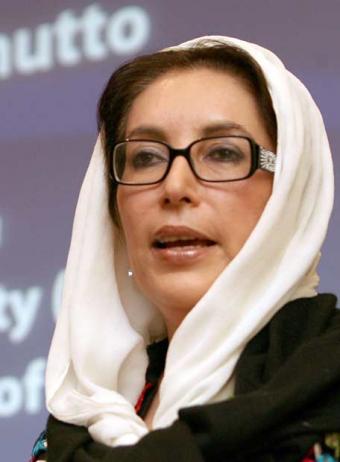

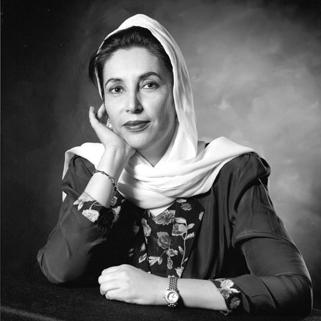

Early Life
Benazir Bhutto - the eldest child of former Pakistani premier Zulfikar Ali Bhutto , was born on June 21, 1953, at Karachi.
Education
Ms. Bhutto attended Lady Jennings Nursery School and then Convent of Jesus and Mary in Karachi. After two years of schooling at the Rawalpindi Presentation Convent, she was sent to the Jesus and Mary Convent at Murree. She passed her O-level examination at the age of 15. In April 1969, she got admission in the U. S. at Harvard University's Radcliffe College. In June 1973, Benazir graduated from Harvard University with a degree in Political Science. After graduating from Harvard, Benazir joined Oxford University in the fall of 1973. Just before graduation, Benazir was elected to the Standing Committee of the most prestigious Oxford Union Debating Society.
In 1976, she graduated in P. P. E. (Politics, Philosophy and Economics). In the autumn of 1976, Benazir returned once again to Oxford to do a one-year postgraduate course. In January 1977, she was elected the President of the Oxford Union.
Return to Pakistan
Benazir Bhutto returned to Pakistan in June 1977. She wanted to join the Foreign Service but her father wanted her to contest the Assembly election. As she was not yet of age, Benazir Bhutto assisted her father as an advisor.
In July 1977, General Zia-ul-Haq imposed Martial Law. - her father was arrested on a murder charge and she was placed under house arrest. Benazir Bhutto became the focus for his followers and, from jail, he continued to advise her what to say to the crowds. After he was hanged in 1979 she felt that she must follow him as leader of the Pakistan People's Party. During the Martial Law, Benazir was allowed to proceed abroad on medical grounds in January 1984, after spending nearly six and a half years in jail. She went into exile in England for two years.
When she returned on April 10, 1986, one million people welcomed her at the Lahore airport. She attended mammoth rallies all over Pakistan and kept in close touch with the Movement for Restoration of Democracy.
Marriage
On December 18, 1987, Benazir married Asif Ali Zardari in Karachi.
Carrier
She contested the elections, which were held by Ghulam Ishaq Khan, who had taken over as acting President after the death of General Zia in an air crash on August 17, 1988, at Bhawalpur.
Benazir Bhutto approached the Supreme Court of Pakistan, seeking enforcement of the fundamental rights guaranteed to the political parties under Article 17(2) of the 1973 Constitution, to hold the elections on Party basis. The Supreme Court gave its verdict in favor of the political parties. The P. P. P., without forming an alliance with any party, won 94 out of 207 seats in the National Assembly. With the cooperation of eight M. Q. M. members and 13 members of the Federally Administered Tribal Areas, the P. P. P. was able to get a clear majority in the National Assemblies. Benazir Bhutto was nominated as the Prime Minister on December 2, 1988, and Ghulam Ishaq Khan was nominated the President of Pakistan.
As a Prime Minister
At the age of 35, she was the youngest and the first woman Prime Minister to lead a Muslim nation in modern age. During her first term, she started Peoples Program for economic uplift of the masses. Benazir Bhutto also lifted a ban on student and trade unions. The P. P. P. Government hosted the fourth S. A. A. R. C. Summit held in Islamabad, in December 1988.
On various issues, differences between her Government and the Establishment led to her dismissal by the President Ghulam Ishaq Khan, on August 6, 1990.
Benazir Bhutto returned to power for the second time in 1993 after the resignation of both President Ghulam Ishaq Khan and Prime Minister Nawaz Sharif on July 18, 1993. The resignation led to the announcement of fresh elections for the National and Provincial Assemblies. The elections were held on October 6 and 9, 1993, respectively.
The elections were boycotted by the M. Q. M. No party emerged with an absolute majority in the elections. As a result the P. P. P. formed the new government with the help of alliances. Benazir Bhutto took oath as Prime Minister on October 19, 1993. The Presidential election was held on November 13. Farooq Ahmad Khan Leghari, the P. P. P. candidate, won by 274 to 168 votes against the then acting President Wasim Sajjad.
During her second tenure, Benazir again faced trouble from the opposition. In the autumn of 1994, Nawaz Sharif led a "train march" from Karachi to Peshawar. This was followed by general strike on September 20. Two weeks later Nawaz Sharif called a "wheel jam" strike on October 11.
The second tenure of Benazir Bhutto was, however, highlighted by the visit of the U. S. first Lady Hillary Clinton and her daughter Chelsea in 1995. Hillary's visit considerably changed the world's perceptions about Pakistan and highlighted Pakistan as a liberal, modern and forward-looking country. In April 1994, Benazir visited the U. S., and projected Pakistan's stance on the F-16 fighter planes withheld by the U. S. despite payments. Her visit resulted in the passing of the Brown Amendment by the U. S. Senate on September 21, 1995, easing restrictions on Pakistan. It also helped in attracting foreign investors. On the domestic front she continued facing problems with M. Q. M. In spite of all her political endeavors, a smooth relationship could not be established between the Government and M. Q. M.
Benazir Bhutto's brother, Mir Murtaza Bhutto, was assassinated under mysterious circumstances in a police ambush on September 20, 1996. The high-profile killing of her brother in her tenure damaged her political career.
Things were not going well between the President and Benazir's Government. Differences soon appeared and the Government felt that there was interference in the political matters of the Government by the President. President Farooq Leghari dismissed Benazir Bhutto's Government on charges of corruption and mismanagement on November 5, 1996, under the Article 58(2) b of the Eighth Amendment.
Update
Bhutto is currently (as of September 2004) based in Dubai, United Arab Emirates, where she cares for her children and mother, who is suffering from Alzheimer's disease and from where she travels around the world giving lectures and keeping in touch with the Party.
Popularity
She has been mentioned as "The world's most popular politician" in the New Guinness Book of Record 1996. The "Times" and the "Australian Magazine" (May 4, 1996) have drawn up a list of 100 most powerful women and have included Benazir Bhutto as one of them.
Death
Bhutto returned to Pakistan on 18 October 2007, after reaching an understanding with President Pervez Musharraf by which she was granted amnesty and all corruption charges were withdrawn. She was assassinated on 27 December 2007, after departing a PPP rally in the Pakistani city of Rawalpindi, two weeks before the scheduled Pakistani general election of 2008 where she was a leading opposition candidate. The following year she was named one of seven winners of the United Nations Prize in the Field of Human Rights.
Zulfiqar Ali Bhutto

Zulfiqar Ali Bhutto was born on January 5, 1928. He was the only son of Sir Shah Nawaz Bhutto. Zulfiqar Ali Bhutto completed his early education from Bombay's Cathedral High School. In 1947, he joined the University of Southern California, and later the University of California at Berkeley in June 1949. After completing his degree with honors in Political Science at Berkeley in June 1950, he was admitted to Oxford.
Zulfiqar Ali Bhutto married Nusrat Isphahani on September 8, 1951. He was called to Bar at Lincoln's Inn in 1953, and the same year his first child, Benazir Bhutto, was born on June 21. On his return to Pakistan, Bhutto started practicing Law at Dingomal's.
In 1958, he joined President Iskander Mirza's Cabinet as Commerce Minister. He was the youngest Minister in Ayub Khans Cabinet. In 1963, he took over the post of Foreign Minister from Muhammad Ali Bogra.
His first major achievement was to conclude the Sino-Pakistan boundary agreement on March 2, 1963. In mid 1964, Bhutto helped convince Ayub of the wisdom of establishing closer economic and diplomatic links with Turkey and Iran. The trio later on formed the R. C. D. In June 1966, Bhutto left Ayub's Cabinet over differences concerning the Tashkent Agreement.Zulfiqar Ali Bhutto launched Pakistan Peoples Party after leaving Ayub's Cabinet. In the general elections held in December 1970, P. P. P. won a large majority in West Pakistan but failed to reach an agreement with Sheikh Mujib-ur-Rahman, the majority winner from East Pakistan. Following the 1971 War and the separation of East Pakistan, Yahya Khan resigned and Bhutto took over as President and Chief Martial Law Administrator on December 20, 1971.
In early 1972, Bhutto nationalized ten categories of major industries, and withdrew Pakistan from the Commonwealth of Nations and S. E. A. T. O. when Britain and other western countries recognized the new state of Bangladesh. On March 1, he introduced land reforms, and on July 2, 1972, signed the Simla Agreement with India, which paved the way for the return of occupied lands and the release of Pakistani prisoners captured in East Pakistan in the 1971 war.
After the National Assembly passed the 1973 Constitution, Bhutto was sworn-in as the Prime Minister of the country.On December 30, 1973, Bhutto laid the foundation of Pakistan's first steel mill at Pipri, near Karachi. On January 1, 1974, Bhutto nationalized all banks. On February 22, 1974, the second Islamic Summit was inaugurated in Lahore. Heads of States of most of the 38 Islamic countries attended the Summit.
Following a political crisis in the country, Bhutto was imprisoned by General Zia-ul-Haq, who imposed Martial Law on July 5, 1977.
On April 4, 1979, the former Prime Minister was hanged, after the Supreme Court upheld the death sentence passed by the Lahore High Court. The High Court had given him the death sentence on charges of murder of the father of a dissident P. P. P. politician.
Zulfiqar Ali Bhutto was buried in his ancestral village at Garhi Khuda Baksh, next to his father's grave.
Abdus Salam was born in Jhang, a small town in what is now Pakistan, in 1926. His father was an official in the Department of Education in a poor farming district. His family has a long tradition of piety and learning. The biography was written by Miriam Lewis, now at IAEA, Vienna, who was at one time on the staff of ICTP (International Centre For Theoretical Physics, Trieste). From Les Prix Nobel. The Nobel Prizes 1979, Editor Wilhelm Odelberg, [Nobel Foundation], Stockholm, 1980 This autobiography/biography was written at the time of the award and later published in the book series Les Prix Nobel/Nobel Lectures. The information is sometimes updated with an addendum submitted by the Laureate. To cite this document, always state the source as shown above.Abdus Salam died on November 21, 1996.


When he cycled home from Lahore, at the age of 14, after gaining the highest marks ever recorded for the Matriculation Examination at the University of the Punjab, the whole town turned out to welcome him. He won a scholarship to Government College, University of the Punjab, and took his MA in 1946. In the same year he was awarded a scholarship to St. John's College, Cambridge, where he took a BA (honours) with a double First in mathematics and physics in 1949. In 1950 he received the Smith's Prize from Cambridge University for the most outstanding pre-doctoral contribution to physics. He also obtained a PhD in theoretical physics at Cambridge; his thesis, published in 1951, contained fundamental work in quantum electrodynamics which had already gained him an international reputation.
Salam returned to Pakistan in 1951 to teach mathematics at Government College, Lahore, and in 1952 became head of the Mathematics Department of the Punjab University. He had come back with the intention of founding a school of research, but it soon became clear that this was impossible. To pursue a career of research in theoretical physics he had no alternative at that time but to leave his own country and work abroad. Many years later he succeeded in finding a way to solve the heartbreaking dilemma faced by many young and gifted theoretical physicists from developing countries. At the ICTP, Trieste, which he created, he instituted the famous "Associateships" which allowed deserving young physicists to spend their vacations there in an invigorating atmosphere, in close touch with their peers in research and with the leaders in their own field, losing their sense of isolation and returning to their own country for nine months of the academic year refreshed and recharged.
In 1954 Salam left his native country for a lectureship at Cambridge, and since then has visited Pakistan as adviser on science policy. His work for Pakistan has, however, been far-reaching and influential. He was a member of the Pakistan Atomic Energy Commission, a member of the Scientific Commission of Pakistan and was Chief Scientific Adviser to the President from 1961 to 1974.
Since 1957 he has been Professor of Theoretical Physics at Imperial College, London, and since 1964 has combined this position with that of Director of the ICTP, Trieste.
For more than forty years he has been a prolific researcher in theoretical elementary particle physics. He has either pioneered or been associated with all the important developments in this field, maintaining a constant and fertile flow of brilliant ideas. For the past thirty years he has used his academic reputation to add weight to his active and influential participation in international scientific affairs. He has served on a number of United Nations committees concerned with the advancement of science and technology in developing countries.
To accommodate the astonishing volume of activity that he undertakes, Professor Salam cuts out such inessentials as holidays, parties and entertainments. Faced with such an example, the staff of the Centre find it very difficult to complain that they are overworked.
He has a way of keeping his administrative staff at the ICTP fully alive to the real aim of the Centre - the fostering through training and research of the advancement of theoretical physics, with special regard to the needs of developing countries. Inspired by their personal regard for him and encouraged by the fact that he works harder than any of them, the staff cheerfully submit to working conditions that would be unthinkable here at the (International Atomic Energy Agency in Vienna (IAEA). The money he received from the Atoms for Peace Medal and Award he spent on setting up a fund for young Pakistani physicists to visit the ICTP. He uses his share of the Nobel Prize entirely for the benefit of physicists from developing countries and does not spend a penny of it on himself or his family.
Abdus Salam is known to be a devout Muslim, whose religion does not occupy a separate compartment of his life; it is inseparable from his work and family life. He once wrote: "The Holy Quran enjoins us to reflect on the verities of Allah's created laws of nature; however, that our generation has been privileged to glimpse a part of His design is a bounty and a grace for which I render thanks with a humble heart."

Allama Iqbal with Choudhery Rehmat Ali

Allama Iqbal With Different Leaders
He was born on 9 November, 1877 at Sialkot. His Father name is Shaikh Nur Muhammad. He received early education from Sialkot. He passed M.A. From Punjab University, Lahore. In 1905 he went England for Higher Studies. He got the degree of PhD from Munich University. He was a Great poet, Philosopher and politician. He was elected to the Punjab provincial legislature in 1927and served as president of the Muslim League in 1930. He was the One of the most prominent leaders of the All India Muslim League, Iqbal encouraged the creation of a "state in northwestern India for Muslims" in his 1930 presidential address called Allahbad Address.He Played a great role in the movement of Pakistan.He Devoted his Life for the Islam.He was a great poet of Urdu, Arabic and Persian. He saw the dream for a separate homeland for the Muslims of Sub-Continent and he created the passion for freedom in their hearts through his poetry. Iqbal encouraged and worked closely with Muhammad Ali Jinnah, and he is known as Muffakir-e-Pakistan ("The Thinker of Pakistan"), Shair-e-Mashriq ("The Poet of the East"), and Hakeem-ul-Ummat ("The Sage of Ummah"). He is officially recognized as the national poet of Pakistan. He was died in April 21, 1938 at Lahore. His tomb is located in the space between the entrance of the Badshahi Mosque and the Lahore Fort, and official guards are maintained there by the Government of Pakistan.

Interior of Iqbal's tomb
In the endless corridors of history, a new name was added in August 1947. It was that of Quaid-e-Azam Muhammad Ali Jinnah, the Founder of Pakistan. Born into a Karachi mercantile family on December 25, 1876, Quaid-e-Azam Muhammad Ali Jinnah had his early schooling at Karachi. Later, he joined the Lincoln’s Inn, to become the youngest Indian barrister to be called to the bar. By sheer native ability and determination, young Jinnah rose quickly to prominence, and soon became a successful lawyer. In 1910 he was elected by Bombay Muslims to the newly constituted Imperial Legislative Council. All through his parliamentary career, which spanned some four decades, he supported or opposed measures solely on their merits. His was also among the most powerful voices in the cause of India’s freedom, Indian’s rights and freedom. He broght the Congress and League together, and was chiefly responsible for the Congress-League Pact (1916) a joint scheme for postwar reforms. For his untiring efforts to effect a communal settlement, he was hailed as “the ambassador of Hindu Muslim Unity”. Since he stood for civic freedoms he resigned from the Imperial Council in 1919, when the Rowlatt Bill was passed into law, and since he stood for “ordered progress”, moderation, gradualism, and constitutionalism, he left the Congress in 1920. Quaid-e-Azam Muhammad Ali Jinnah re-organized the League of which he was President since 1916, and devoted the next seven years to bringing about unity among Muslim ranks. Despaired alike of the “negative” Congress attitude and of chronic disunity in Muslim ranks, he went into self-exile in London (1931), but returned to India in 1934 at the fervent appeal of the Muslims, became the President of the reunited Muslim League, and assumed its leadership. In 1940, he spelled out the concept of Muslim nationhood, asserting that “We are a nation, with our own distinctive culture and civilization, language and literature, art and architecture, names and nomenclature, sense of value and proportion, legal laws and moral code, customs and calendar, history and traditions, aptitudes and ambitions. Despite the vehement opposition of the Congress and the antipathy of the British to his demand Quaid-e-Azam Muhammad Ali Jinnah organized his movement so adroitly that the Pakistan Movement gathered momentum within a few years, became the central issue in all subsequent constitutional proposals, and was overwhelmingly voted for by Muslims in the 1945-46 general elections. Pakistan was finally established on 14 August, 1947, he became first Governor-General of Pakistan.

In Lahore
In Karachi
In Karchi, big TV Screen
In Islamabad


Subscribe to:
Posts (Atom)